


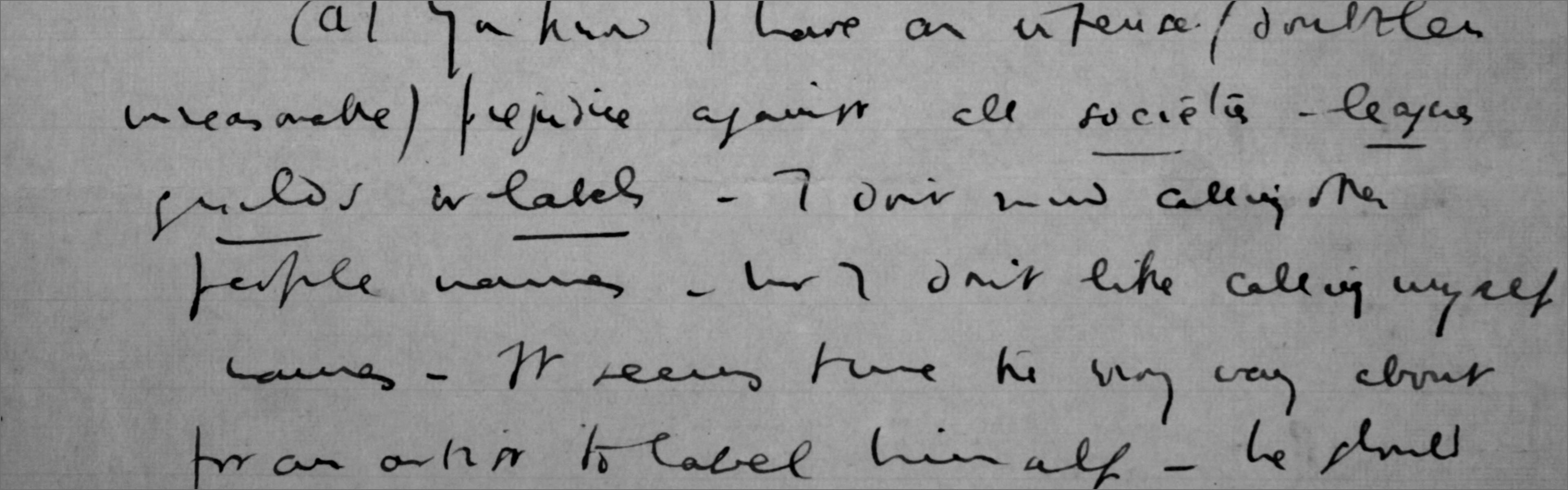


Letter from Ralph Vaughan Williams to the Editor of the Eastern Daily Press
Letter No. VWL5335
Letter from Ralph Vaughan Williams to the Editor of the Eastern Daily Press
Letter No.: VWL5335
13, Cheyne Walk, London, S.W.
1 April 1913
THE REFORM OF CHURCH MUSIC.
To the Editor.
Sir
Your contributor, Mr. Reginald F. Rynd, in an article with which I am on the whole in profound disagreement, writes as follows on the profound subject of folk-song:-
“The attempt to revive a national interest in the old folk-music … has met with limited response, and before it will be very possible to attune the modern ear to the old tonality, it will be necessary to remove the deeply rooted attachment to the modern diatonic scale with all the aesthetic prepossessions which this involves.
It would be hard to find another example of so many mistakes crammed into so few words.
To start with, folk-song is not something old: it exists, as Sir Charles Stanford has, I think, said, “for all time”. A folk-song is like a tree, its root and trunk may belong to past ages, but it is continually being revivified by fresh shoots, leaves, and blossoms. The present interest in folk-song is not a “revival”, but a development.
Secondly, if Mr. Rynd knew anything about modern music he would be aware that much of it depends for its very modernity both of melody and harmony on these “old” tonalities. And lastly the response to the folk-song “revival” has been anything but “limited”. No serious artistic movement has ever made such a stir in England as this – men and women who though that they had no love for music have suddenly had that love awakened. Everyone who hears our folk-songs, from the learned musician to the school child, yields to their fascination.
Folk-songs are the most popular numbers in popular concerts, and, what is more important, British composer are beginning to feel their power. Among the older musicians who have vitalised their art from the fountain head of folk-song I mention Sir C.V. Stanford and Mr. McCunn, while among the younger men it is enough to point to Mr. Grainger among many others who have found that their art lives just in so far as it strikes taproots into our national melody.
Yours faithfully,
R. VAUGHAN WILLIAMS.
-
To:
-
From:
-
Names:
-
Subject:
-
Format:
