




ABOUT THE LETTERS
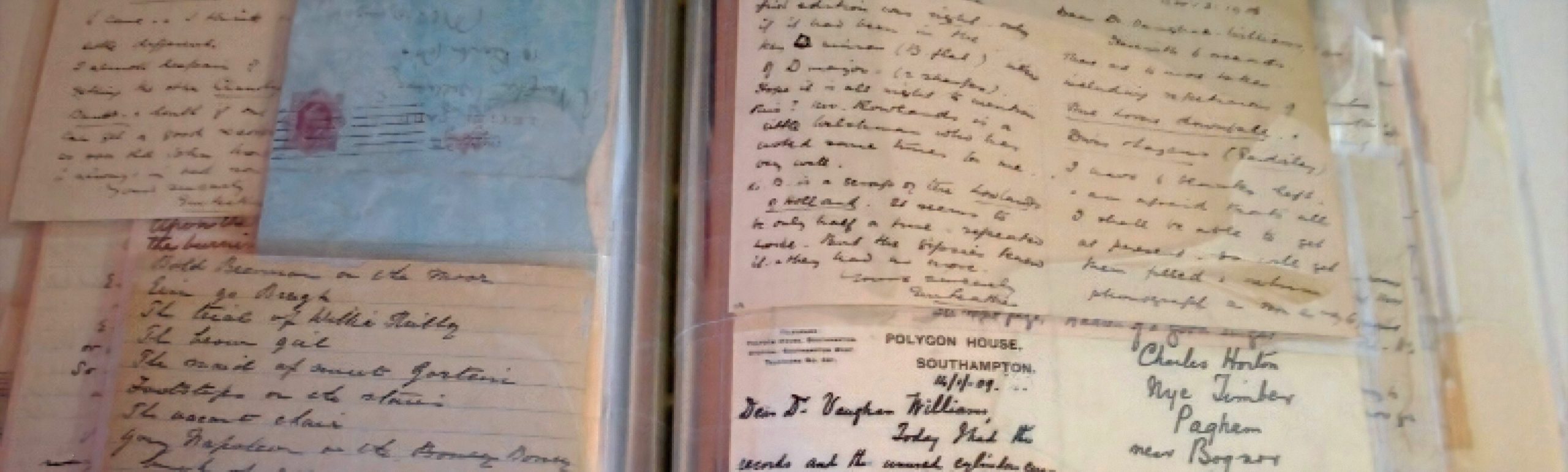
Ralph Vaughan Williams’s correspondence - with his friends, family, pupils and fellow musicians - paints an intriguing portrait of the man, as well as providing fascinating insights into his major preoccupations: musical, personal and political.
The VWF database includes transcripts of over 5,000 items of annotated correspondence, fully indexed and searchable, which can all be read online. It includes all the letters of Ralph Vaughan Williams known to the editors and is an ongoing project. Find out more about the database.
The text of letters written by Ralph Vaughan Williams remains in the copyright of the Vaughan Williams Foundation and may not be further reproduced without the prior written consent of the Foundation.
Featured Letter
from Vaughan Williams, Ursula, 1911-2007 to Glover, Cedric, fl.1924-1968
Letter No. VWL4331
Letter from Ursula Vaughan Williams to Cedric Glover
Letter No.: VWL4331
From R. Vaughan Williams,
10, Hanover Terrace,
Regents Park,
London, N.W.1.
November 26th [1954]
My dear Cedric,
Frederick Grinke & Michael Mullinar are coming here on Sunday December 18th to play Ralph’s sonata1 & we should love it if you & Peggie could come – 6 o’clock, & sherry.
Love from us both,
Ursula
1. The Sonata in A minor for violin and piano, Catalogue of Works 1954/4. This was by the dedicatee, Frederick Grinke, accompanied by Michael Mullinar; there had been a similar private performance in September 1954 before it was broadcast in October, when the VWs were abroad. See VWL2875.
-
To:
-
From:
-
Scribe:
-
Names:
-
Musical Works:
-
Format:
-
Location Of Original:
-
Shelfmark:MS Mus. 1116, f.166
